Breast Cancer Screening & Diagnosis
Screening for Breast Cancer
Breast cancer screening isn’t just about finding cancer — it’s about taking care of yourself. Screening can bring up fear, worry, or even painful memories, but understanding your options can give you confidence and peace of mind. These are common tests according to the CDC:
Mammogram: A mammogram is an X-ray of the breast and the most effective screening tool for most women. It can detect tumors that are too small to feel.
Clinical Breast Exam (CBE): During a clinical breast exam, a doctor or nurse checks your breasts for lumps or changes.
Breast Self-Awareness: Get familiar with how your breasts normally look and feel. That way, you’ll notice changes like new lumps, skin dimpling, or nipple discharge — and can talk to your doctor right away.
Other Imaging Tests: Sometimes, your doctor may order an ultrasound or MRI, especially if you have dense breast tissue, a family history, or unclear mammogram results.
Diagnostic Tests (After an Abnormal Screening)
According to the CDC, If your doctor finds something that needs a closer look, you may have:
Diagnostic Mammogram: A more detailed mammogram that focuses on the area of concern.
Ultrasound: Uses sound waves to show if a lump is a solid mass or a fluid-filled cyst.
Breast Magnetic Resonance Imaging (MRI): Uses a strong magnet and computer technology to produce clear, detailed pictures of the breast tissue.
Biopsy: If imaging shows something suspicious, your doctor may remove a small sample of tissue (biopsy) to test for cancer cells.
Understanding Breast Density
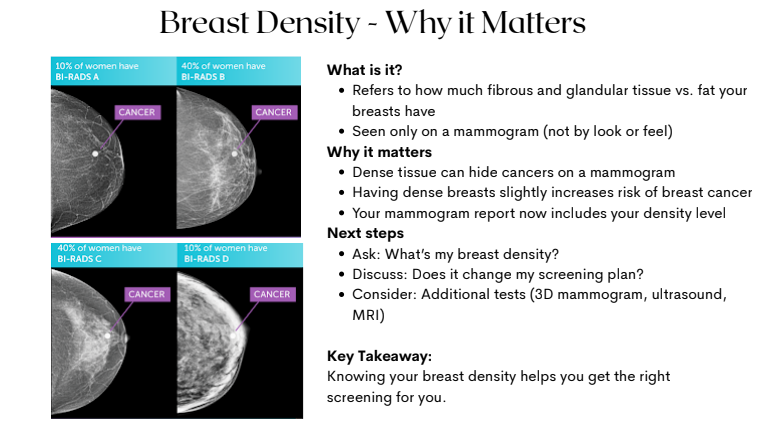
Every woman’s breasts are different — and so is what they’re made of. According to American Cancer Society, Breasts are made up of fatty tissue, fibrous tissue, and glandular tissue. The amount of these tissues varies from person to person.
If your mammogram report says you have “dense breasts,” that simply means you have more fibrous and glandular tissue and less fatty tissue. Dense breast tissue is very common and completely normal — but it’s important to understand what it means for screening.
Why Breast Density Matters
Dense tissue can make it harder to see changes on a mammogram. Both dense tissue and tumors appear white on the image, which can make small cancers harder to spot.
Dense breasts are linked to a slightly higher risk of breast cancer. Doctors don’t fully understand why, but it’s one factor to be aware of — especially when planning your screening schedule.
Caring for Your Emotional Wellbeing
Waiting for test results or facing follow-up testing can be incredibly stressful. You’re not alone.
It’s normal to feel anxious, angry, or uncertain. Here are a few ways to take care of yourself:
Bring a friend or loved one to appointments.
Write down your questions before visits.
Try deep breathing, prayer, or gentle movement to calm your mind.
Reach out to others who’ve been there.